


Social Media in Sports: Who are the Winners and Losers?
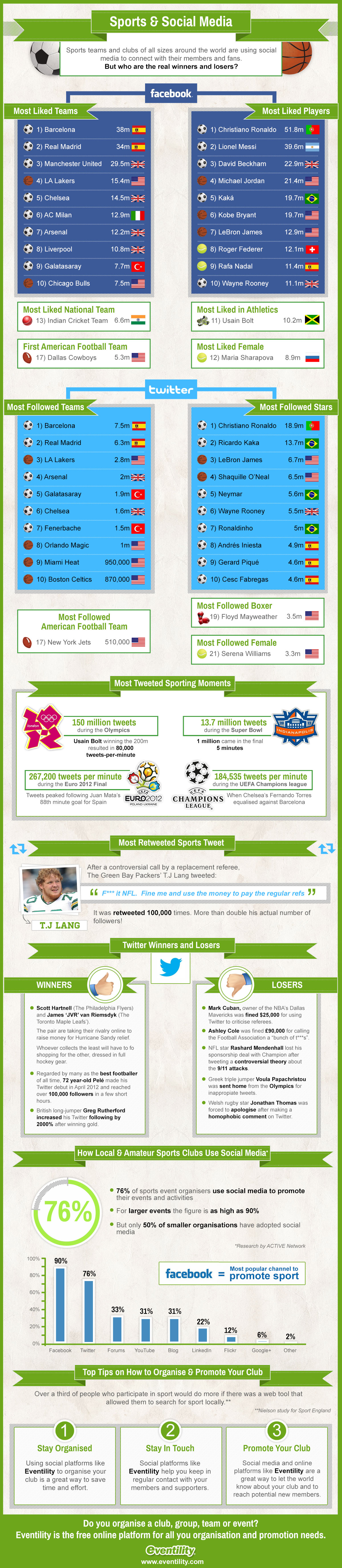
Sports and social media make a great team. Whilst fans follow the action, they can share the moment with their friends and fellow supporters. But who is making the most of this relationship? And who would be best advised to keep clear of Twitter altogether? This new infographic from Eventility, a platform that helps clubs and groups promote their activities online, identifies some of the biggest ‘winners and losers’.
Perhaps the key takeaway is the lack of US dominated sports in the lists of most followed teams and athletes on Twitter and Facebook. With football (soccer) accounting for over half of these and basketball and tennis making up the rest, there is no room for baseball, American football or ice hockey.
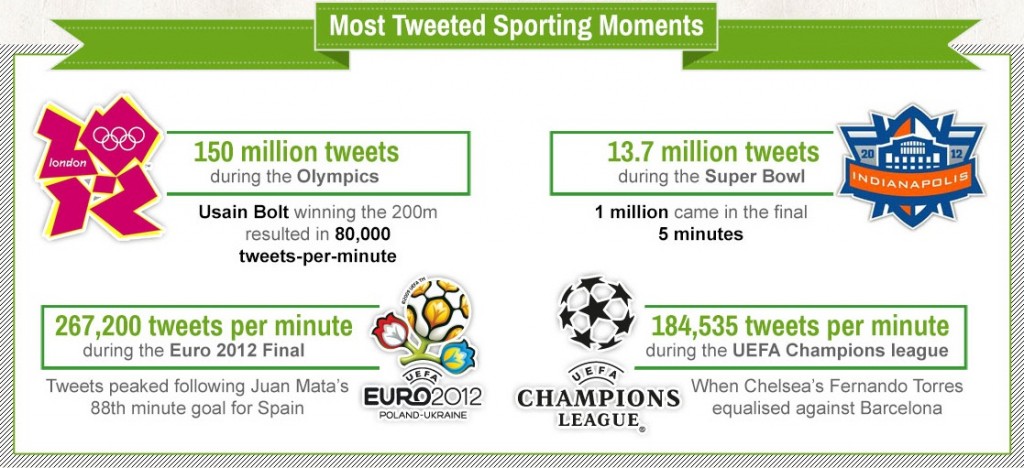
Having said that, the US fares significantly better when it comes to the ‘most tweeted sporting moments’. Last year’s Super Bowl produced 13.7 million tweets and over 1 million of those came in the final 5 minutes of the game. American football also produced the most retweeted sports tweet of all time when the Green Bay Packers’ T.J Lang tweeted “F*** it NFL. Fine me and use the money to pay for regular refs”.
This resulted in an impressive 100,000 retweets, significantly more than his actual number of followers. Looking at the losers, there are just too many to choose from. In the world of football, Ashley Cole, Rio Ferdinand, Carlton Cole, Joey Barton, Jack Wilshere and Ryan Babel have all landed themselves in trouble through their tweets.
But the problem is by no means exclusive to footballers, some other notable fails include:
- Lewis Hamilton tweeted a photo of confidential team data and falsely accused his teammate, Jenson Button, of unfollowing him.
- Greek triple jumper Voula Papachristou was sent home from the Olympics for posting a racist remark to Twitter.
- NFL star Rashard Mendenhall lost a sponsorship deal after tweeting a controversial theory about the 9/11 attacks.
- Welsh rugby player Jonathan Thomas was forced to apologise after making a homophobic comment on Twitter.
Of course, social media is not only for the world-renowned. Local sports clubs and teams can also reap the benefits and are increasingly doing so. According to Eventility, 76% of sports organisers use social media to promote their events, though this figure is only 50% for smaller events. Given the opportunities now available, I would expect this figure to greatly increase in the future.
Comment below on how you choose to follow and participate in sports social media. Make sure to like SportsNetworker on Facebook, tweet out this article and follow us @SportsNetworker
Show recommendations are based on artists users ‘like’ on Facebook, actions they take in the calendar, affinity
artists, and artists they’re listening to on Spotify. Jennifer Lawrence, Justin bieber, java, Justin timberlake,. The outdoor concert facility across the river from Philadelphia (in Camden, NJ) known as the Susquehanna Bank Center has announced ten concert enhancing features for the upcoming summer season. However, you can still access it to change your settings or to set your Roku HD player to display error messages when the streaming isn’t working properly.
listen to how the orchestra mirrors Marguerite’s mood as she goes through various phrases of distress; pensive longing, panic at the realization of her abandonment, remembrance of Faust’s physical presence.
Excellent publish, very informative. I wonder why the opposite specialists of this sector don’t realize this. You should proceed your writing. I’m confident, you’ve a great readers’ base already!|What’s Happening i’m new to this, I stumbled upon this I have found It absolutely useful and it has helped me out loads. I’m hoping to contribute & aid different users like its aided me. Good job.
I lovе loߋking at yօur іnternet site. thnx!
Ilike reading an article that will make people think.
Also, thanks for allowing for me to comment!
The company offers low cost service and makes shipping process convenient.
The company promotes empowerment by spending lavishly on research and
development, encouraging technical employees to spend 15 percent of their work time on research projects of their choice and promoting a culture of
cooperation that transcends department boundaries.
Before the health insurance exchanges become fully operational, health insurance payers would need to have their business models, market
strategies, IT systems and technologies, operational designs etc.
Your small appliances can remain hidden in these shelves and still be easily accessible.
They can offer you you the widest range of new modern designs
that can fit your home perfectly. So wiping water into the sink and cleaning up
is quicker.
Females of the species prefer to mate with those males that are brighter and have more color.
If you speak to Tortimer on any of these days, he will give you either
a sparkler or a Roman candle. You have to understand that you
need these considerations to experience a decent, if
not, normal abortion clinic Virginia experience.
There are now select plastic surgeons that offer affordable payment plans on their plastic surgery procedures for their clients.
The “Basketball Wives LA” star also made waves recently when she appeared with Drake and Blake Griffin in a skit for the ESPY Awards.
Some proper money movement and a breakaway from
the Dolphins could land the tackle in an offense far better suited for his talents.
* 32 percent thought that looking younger would affect their job performance more positively.
may be recommended to restore a youthful appearance to the face.
Breast reconstruction, for those who have undergone a mastectomy, as well as cleft lip and palate surgery are common examples of reconstructive
surgeries.
Thanks for the information your post brings. I see the novelty in your text, I will share it for everyone to read. I look forward to reading more articles from you.